

What Are Screws? Definition and Applications
Screws are mechanical fasteners featuring a helical thread formed around a cylindrical or tapered shaft. They are designed to create secure connections by engaging with internal threads, pre-drilled holes, or suitable materials. Unlike permanent fastening methods such as welding or certain types of riveting, many screw connections can be disassembled when maintenance, adjustment, or component replacement becomes necessary.
Screws are widely used in industries ranging from residential construction and furniture manufacturing to automotive assembly, electrical equipment, industrial machinery, and precision electronics. Their versatility comes from the large number of available designs, each intended to address specific material properties, installation conditions, and mechanical requirements.
A typical screw consists of several important components: the head, drive recess, shank, external thread, and point. The head provides a bearing surface or a method of applying torque. The drive recess allows a screwdriver or power tool to rotate the fastener. The threaded portion develops engagement with the receiving material, while the point geometry determines how the screw starts entering the workpiece.
Key Takeaway: Screws are not interchangeable simply because they have similar dimensions. Their performance depends on thread geometry, base material compatibility, head design, mechanical properties, and installation conditions.
Where Are Screws Commonly Used?
- Construction: Connecting timber framing, drywall systems, roofing panels, and building components.
- Furniture: Assembling cabinets, shelves, desks, chairs, and modular furniture.
- Metalworking: Fastening sheet metal, enclosures, brackets, and fabricated components.
- Electronics: Securing circuit board assemblies, device housings, and precision components.
- Automotive manufacturing: Attaching interior trim, panels, brackets, and serviceable assemblies.
- Industrial machinery: Supporting equipment assembly, maintenance access, and replaceable parts.
Why Are Screws Important? Benefits and Common Fastening Challenges
Screws play an important role in manufacturing and construction because they provide a practical balance between connection strength, installation convenience, serviceability, and cost. When properly specified, screws can maintain reliable joints while allowing parts to be removed or replaced without destroying the entire assembly.
1. Reliable Mechanical Connections
Correctly selected screws can resist separation and contribute to the transfer of mechanical loads between connected parts. In suitable clamped joints, tightening generates preload that helps hold components together. The required strength depends on fastener properties, thread engagement, substrate strength, and the direction of loading.
2. Convenient Assembly and Maintenance
Many screw connections can be removed using standard hand tools or controlled power drivers. This makes them useful for assemblies requiring inspection, maintenance, adjustment, or replacement. However, repeated removal may wear threads in softer materials, so reusability should always be evaluated for the actual joint design.
3. Compatibility With Different Materials
Specific screw designs are available for timber, metal, plastic, masonry, and composite materials. Each substrate has different hardness, elasticity, and resistance to thread deformation. Choosing a compatible fastener helps reduce cracking, stripping, loosening, and premature joint failure.
4. Efficient Production and Installation
Screws support manual assembly and automated manufacturing. Depending on the application, self-drilling designs may combine hole creation and fastening into one operation, while machine screws provide repeatable engagement with correctly manufactured internal threads. Selecting the correct fastening process can reduce assembly time and improve consistency.
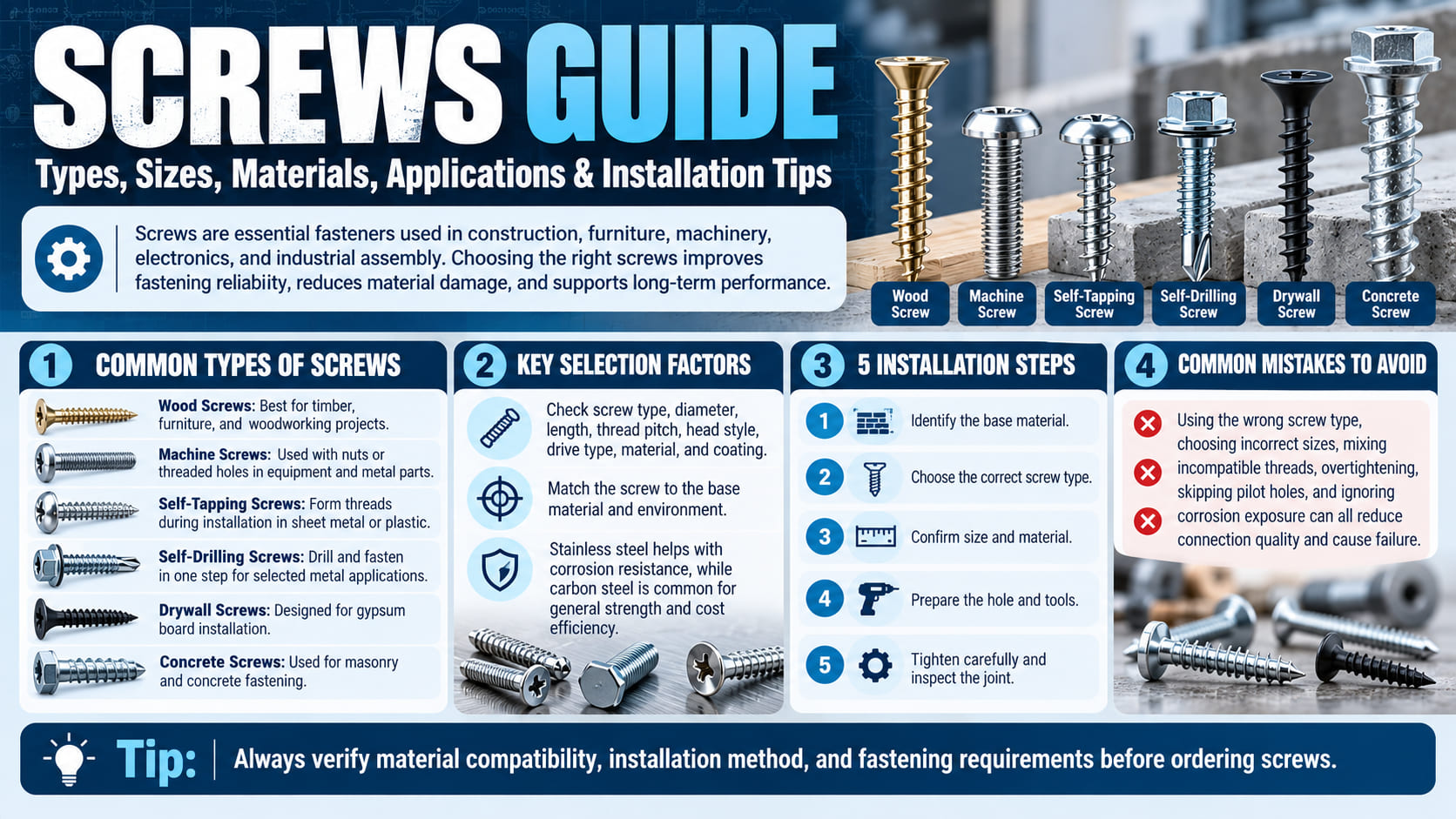
Common Types of Screws and Their Uses
Different types of screws serve different fastening purposes. Understanding their construction and intended applications is the first step toward selecting reliable fasteners for professional projects or everyday repairs.
1. Wood Screws
Wood screws are designed to create secure connections within timber and wood-based products. They commonly feature relatively deep threads to engage wood fibers effectively. Depending on the design, they may have a partially threaded shank that helps draw two wooden components tightly together.
These screws are frequently used in furniture manufacturing, cabinetry, woodworking, interior finishing, and certain construction applications. Pilot holes may be necessary when working with hardwood, brittle material, large fasteners, or locations close to board edges.
2. Machine Screws
Machine screws typically feature uniform external threads and are designed to engage with threaded holes or matching nuts. They are widely used in machinery, electronics, electrical equipment, metal assemblies, and precision manufacturing.
Machine screws are available in metric and inch-based thread systems. Selecting the correct diameter, pitch, thread tolerance, and strength specification is essential to prevent thread damage and achieve consistent joint performance.
3. Self-Tapping Screws
Self-tapping screws are designed to form or cut mating threads as they are installed. Depending on the specific screw design and receiving material, they may require a prepared pilot hole or another suitable starting opening.
They are commonly used in sheet metal, plastic housings, appliance manufacturing, and light industrial assemblies. Their thread geometry must match the substrate to avoid excessive insertion torque, cracking, or loss of holding strength.
4. Self-Drilling Screws
Self-drilling screws feature a specially designed drilling point that can create a hole and engage the material during the same installation process. They are particularly useful for selected metal-to-metal and metal-to-wood applications where the screw's drilling capacity matches the substrate thickness and hardness.
These screws are often found in metal roofing, cladding systems, steel framing, and sheet metal fabrication. Unlike conventional self-tapping screws, their drilling point is specifically intended to perform the initial hole-making operation. The correct point design is essential because drilling capability varies by product.
5. Drywall Screws
Drywall screws are primarily designed to attach gypsum board to suitable wood or metal framing. Their head geometry is intended to seat within the drywall surface without tearing through the facing paper when correctly installed.
Although drywall screws are convenient and widely available, ordinary drywall screws should not be substituted for structural screws without appropriate engineering verification. Their mechanical characteristics and intended uses differ from fasteners designed for structural connections.
6. Concrete and Masonry Screws
Concrete screws are engineered for fastening into suitable masonry or concrete substrates. Many systems require a precisely sized and cleaned drilled hole before installation. Their thread design engages the base material to provide anchoring resistance.
Installation depth, substrate condition, edge distance, spacing, and manufacturer approval are important considerations. Applications involving safety-critical loads should follow the specified anchor system and applicable engineering requirements.
7. Socket Head Cap Screws
Socket head cap screws are commonly used in machinery, industrial equipment, fixtures, and precision assemblies. Their internal hexagonal drive permits installation using a matching hex key or socket tool, which can be convenient in compact equipment layouts.
These fasteners are available in different materials and property classes. Their suitability depends on the required clamping force, available clearance, operating environment, and mechanical design of the connection.
Understanding Screw Sizes, Threads, Head Styles, and Materials
Correct screw selection requires more than identifying the general screw category. Dimensions, thread pitch, head configuration, drive style, and material properties all affect installation and performance. For manufacturers and procurement teams, these characteristics should be clearly identified before an order is placed.
Screw Diameter and Length
Screw diameter generally refers to the nominal outside diameter of the threaded portion. Length is measured according to the fastener's head design and applicable product standard. For many non-countersunk screws, the nominal length is measured from beneath the head to the end, while many countersunk screws are measured by overall length.
Choosing the correct length ensures adequate engagement without damaging components behind the fastening surface. Excessively short screws may provide insufficient holding strength, while overly long screws may penetrate unintended surfaces or interfere with internal components.
Metric and Imperial Thread Systems
Metric machine screws commonly use an M designation followed by the nominal diameter. For example, an M6 screw has a nominal thread diameter of 6 mm. A designation such as M6 × 1.0 identifies a 1.0 mm thread pitch, meaning the axial distance between corresponding points on adjacent thread turns is 1.0 mm.
Inch-based systems commonly specify nominal size and threads per inch, such as 1/4-20 UNC. Metric and inch-based threads should not be mixed simply because their dimensions appear similar. Incorrect thread matching can damage the fastener and receiving component.
Common Screw Head Styles
- Flat Head: Often used for countersunk installation where a flush surface is desired.
- Pan Head: Provides a generally flat bearing surface and rounded top profile.
- Button Head: Offers a low-profile rounded appearance in suitable machine screw applications.
- Hex Head: Allows tightening using a wrench or socket.
- Socket Head: Uses an internal drive, commonly hexagonal, for controlled installation.
- Truss Head: Provides a broad bearing surface for selected sheet metal and assembly applications.
Common Screw Materials
Carbon steel screws are commonly selected for applications requiring economical fastening and appropriate mechanical strength. Protective coatings may be applied to improve corrosion resistance.
Stainless steel screws are frequently used where corrosion resistance matters, including outdoor installations, food-processing equipment, and certain industrial environments. However, stainless steel grades differ in corrosion resistance and mechanical properties, and stainless steel is not immune to corrosion.
Brass screws are sometimes selected for decorative hardware, electrical applications, and installations requiring particular material characteristics. Their lower strength compared with many steel fasteners must be considered.
Alloy steel screws can offer higher mechanical strength when manufactured and heat-treated to an appropriate property class. These screws are commonly used in machinery and engineered assemblies, although corrosion protection may still be necessary.
How to Choose and Install Screws Correctly: 5 Essential Steps
Selecting and installing screws correctly is a systematic process. Whether working with timber, fabricated metal, machinery, or manufactured products, following these five steps can reduce installation problems and improve fastening consistency.
Step 1: Identify the Base Material and Application
Begin by identifying the materials being connected. Wood, aluminum, carbon steel, stainless steel, plastic, and concrete all respond differently to fastening forces. Consider whether the connection is permanent, removable, decorative, load-bearing, or exposed to vibration.
Also determine whether the joint will experience tensile loads, shear loads, repeated movement, or environmental exposure. A screw that works well for attaching decorative trim may be unsuitable for a structural or safety-critical connection.
Step 2: Select the Correct Screw Type and Thread Design
Choose a fastener type appropriate for the receiving material and fastening process. Wood screws engage wood fibers, machine screws engage compatible internal threads, and specific self-tapping screws create mating threads in prepared openings or suitable materials.
For metal fabrication, determine whether drilling will be performed separately or whether a correctly rated self-drilling screw is suitable. When fastening brittle plastics, consider specialized thread-forming designs that reduce stress concentrations.
Step 3: Confirm Screw Dimensions and Material
Verify the nominal diameter, length, thread pitch, head dimensions, and drive configuration. For machine screws, check compatibility with the matching nut or threaded hole. For wood screws, consider material thickness and the required penetration depth.
Material selection should reflect corrosion exposure, mechanical requirements, and compatibility with adjacent components. Where dissimilar metals are used, assess the risk of galvanic corrosion under the expected environmental conditions.
Step 4: Prepare the Hole and Installation Tools
Prepare the receiving material according to the screw manufacturer's instructions. Some screws require accurately sized pilot holes, while others are designed for installation without separate drilling in specified substrates.
Use the correct screwdriver bit or socket to ensure proper engagement with the head. Incorrect or worn tools can damage the drive recess, cause slipping, and increase the risk of stripped screws. When necessary, use clamps to keep components aligned during installation.
Step 5: Tighten and Inspect the Connection
Start the screw in alignment with the intended hole and apply controlled rotational force. Avoid excessive speed or pressure that may damage the threads, head, or base material. For engineered joints, follow the specified tightening procedure and torque requirements rather than relying on an arbitrary setting.
After installation, inspect the connection for proper seating, alignment, damaged materials, and visible gaps. If the screw spins without tightening, the receiving threads may be stripped or the hole may be oversized. Correct the underlying problem rather than forcing further tightening.
Screw Types Comparison Table: Applications and Selection Considerations
The following comparison provides a practical overview of common screws, their typical applications, and important considerations. Actual suitability should always be confirmed against the fastener's specifications and installation requirements.
| Screw Type | Typical Application | Key Feature | Selection Consideration |
|---|---|---|---|
| Wood Screws | Furniture and timber connections | Threads designed for wood engagement | Wood density and pilot hole requirements |
| Machine Screws | Machinery and metal assemblies | Uniform machine threads | Matching thread diameter and pitch |
| Self-Tapping Screws | Sheet metal and plastic assemblies | Creates mating threads | Hole preparation and substrate compatibility |
| Self-Drilling Screws | Metal roofing and steel framing | Integrated drilling point | Rated drilling thickness and material hardness |
| Drywall Screws | Gypsum board installation | Head designed for drywall seating | Framing material and installation depth |
| Concrete Screws | Masonry and concrete fastening | Specialized anchoring threads | Drilled hole geometry and approved loads |
| Socket Head Cap Screws | Industrial machinery and precision assemblies | Internal hex drive | Strength class and tightening requirements |
Common Screw Selection and Installation Mistakes to Avoid
Even high-quality screws may perform poorly when selected or installed incorrectly. Understanding common fastening mistakes helps manufacturers, contractors, and maintenance teams prevent unnecessary damage, rework, and connection failures.
- 1. Choosing the Wrong Screw Type: Using ordinary wood screws in applications requiring engineered structural fasteners can result in inadequate connection performance. Always match the screw to the intended function.
- 2. Selecting Incorrect Dimensions: Screws that are too short may provide insufficient engagement, while screws that are too long may damage hidden components or penetrate finished surfaces.
- 3. Ignoring Thread Compatibility: Mixing metric and imperial threads or using an incorrect pitch can destroy mating threads and reduce the reliability of the connection.
- 4. Applying Excessive Tightening Torque: Overtightening can strip receiving threads, deform components, crack brittle materials, or damage the screw itself.
- 5. Skipping Required Pilot Holes: Driving screws directly into dense timber, brittle materials, or incorrectly prepared metal can cause splitting, excessive installation torque, or fastener failure.
- 6. Using Inappropriate Materials Outdoors: Screws without suitable corrosion protection may deteriorate prematurely in humid, coastal, chemically aggressive, or weather-exposed environments.
- 7. Reusing Damaged Screws: Fasteners with stripped heads, damaged threads, corrosion, or permanent deformation may no longer provide reliable performance. Replacement is generally preferable when condition or serviceability is uncertain.
A practical way to reduce these problems is to create a fastening checklist before installation. Confirm the material, screw specification, hole requirements, tools, and tightening procedure. For repeated manufacturing operations, documented installation instructions and quality checks can improve consistency across production batches.
Advanced Screw Selection and Installation Techniques
For more demanding applications, effective screw selection requires attention to details beyond basic size and type. Engineers, purchasing specialists, and experienced installers should evaluate joint performance, operating conditions, and manufacturing consistency.
1. Evaluate Mechanical Loads and Joint Design
Determine whether the connection primarily experiences tension, shear, vibration, thermal movement, or combinations of these conditions. The number and arrangement of screws, thread engagement, clamped material properties, and local stresses all influence connection performance.
For engineered or safety-critical joints, use applicable design standards, verified product performance data, and qualified engineering calculations rather than selecting screws by appearance alone.
2. Use Appropriate Torque Control
Controlled tightening is particularly important in machinery, precision equipment, and high-volume manufacturing. Torque tools can improve repeatability, but applied torque does not translate directly into a fixed clamping force because friction, coatings, lubrication, and thread condition affect preload.
Always use application-specific tightening specifications. Excessive torque may damage the joint, while insufficient tightening can allow movement or loosening.
3. Consider Corrosion and Environmental Exposure
Fasteners installed outdoors or in industrial environments may face moisture, salts, chemicals, temperature changes, and other corrosive influences. Choosing a suitable material or coating can extend service life and reduce maintenance requirements.
Stainless steel, coated carbon steel, and specialty fastener materials have different advantages and limitations. The complete environment and mating materials should be assessed instead of assuming one material is universally suitable.
4. Prevent Loosening in Vibrating Assemblies
Connections exposed to repeated vibration or dynamic loading may require additional design measures. Depending on the joint, these can include verified locking features, appropriate preload, suitable thread-locking compounds, or redesigned clamping arrangements.
The appropriate solution depends on the fastener type, joint geometry, expected service loads, and maintenance requirements. A locking product should not be used to compensate for an incorrectly designed connection.
5. Verify Standards and Supplier Specifications
When purchasing screws for industrial applications, ask suppliers to identify the applicable dimensional standard, material specification, mechanical property class, thread designation, surface finish, and relevant inspection requirements.
International standards help establish consistent terminology and dimensional expectations. For example, ISO metric screw thread specifications define relevant thread dimensions and pitch combinations. Confirm that any quoted standard applies to the specific product being ordered rather than assuming all screws follow the same specification.
Conclusion: How to Select the Right Screws for Reliable Fastening
Screws are essential components in construction, manufacturing, furniture production, electronics, and industrial equipment. Although they are relatively small, their influence on assembly quality, maintenance, and connection reliability can be significant.
Selecting the right screws begins with understanding the materials being joined and the mechanical requirements of the application. From there, consider the screw type, diameter, length, thread design, head style, drive configuration, and material. Proper hole preparation and controlled installation are equally important.
For simple household work, these principles help avoid splitting materials and damaging fasteners. For industrial production, they support more consistent assembly, easier maintenance, and better quality control. In either case, choosing screws based on actual specifications rather than appearance or price alone is the more reliable approach.
Next Step: Before purchasing screws for your next project, prepare a specification checklist covering screw type, material, diameter, length, thread pitch, head style, coating, quantity, and operating conditions. For industrial or custom applications, consult a qualified fastener supplier or engineer to confirm compatibility and performance requirements.
Screws FAQ: Frequently Asked Questions
Q1: What are screws used for?
Screws are used to connect materials and components in construction, furniture, machinery, electronics, and industrial manufacturing. Their threaded design provides mechanical engagement with compatible materials or internal threads. Many screw connections can also be removed for maintenance or replacement, making them useful in assemblies that require service access.
Q2: What is the difference between screws and bolts?
Screws and bolts are both threaded fasteners, but their terminology often reflects how they are installed. Bolts are commonly associated with joints using nuts, while screws often engage tapped holes or create their own mating threads. However, terminology varies across industries and standards, so the specific product definition should always be checked.
Q3: What are the most common types of screws?
Common screw categories include wood screws, machine screws, self-tapping screws, self-drilling screws, drywall screws, concrete screws, and socket head cap screws. Each category is designed for particular materials and fastening processes. The best choice depends on substrate compatibility, connection requirements, installation methods, and expected service conditions.
Q4: How do I choose the correct screw size?
Choose screw dimensions based on material thickness, required thread engagement, available installation depth, and mechanical loading. For machine screws, verify the nominal diameter and thread pitch against the mating components. Avoid selecting screws solely by visual appearance, because small dimensional differences can affect compatibility and connection performance.
Q5: Are stainless steel screws better than carbon steel screws?
Neither material is universally better. Stainless steel screws are often preferred where corrosion resistance is important, while carbon steel screws may provide an economical option with suitable mechanical properties and protective coatings. The correct choice depends on the application, strength requirements, environmental exposure, and compatibility with surrounding materials.
Q6: What is the difference between self-tapping and self-drilling screws?
Self-tapping screws create mating threads during installation, often in a prepared opening or suitable softer material. Self-drilling screws additionally include a drilling point designed to create the initial hole in specified substrates. These designs should not be treated as interchangeable because their installation requirements and drilling capabilities differ.
Q7: Do screws always require pilot holes?
No. Pilot hole requirements depend on the screw design, receiving material, and installation conditions. Certain self-drilling and specially designed wood screws can be installed without separate pilot drilling in suitable materials. However, pilot holes may be necessary for hardwood, brittle substrates, threaded metal applications, or installations near material edges.
Q8: Why do screws become loose over time?
Screws can loosen because of vibration, repeated loading, material compression, thermal movement, insufficient preload, or damaged receiving threads. Preventive measures may include suitable tightening procedures, verified locking features, regular inspections, and improvements to joint design. The appropriate solution depends on the actual cause of loosening.
Q9: Can screws be reused after removal?
Some screws can be reused when their design and condition permit, but reuse is not always appropriate. Inspect the threads, head, corrosion condition, and any permanent deformation before considering reuse. Fasteners used in critical joints, damaged threads, or applications with special locking features may require replacement according to the manufacturer's instructions.
Q10: What information should I provide when ordering industrial screws?
Industrial screw orders should specify the screw type, nominal diameter, length, thread pitch, head style, drive configuration, material, coating, quantity, and applicable standards. For demanding applications, include mechanical property requirements, tolerances, operating conditions, and relevant drawings. Detailed specifications help suppliers confirm compatibility and reduce ordering errors.